 Daily Knowledge
 "If you have God on your side, everything becomes clear."
[Ayrton Senna]
Quote of the Day, from brainyquote.com (2026/09/20)
Article of the Day

Misti is a volcano in the southern Peruvian Andes, rising above Arequipa, Peru's second-largest city. Because it is only 12 km (8 mi) from Arequipa and its million-plus inhabitants, it is considered one of the world's most dangerous volcanoes. Narrow valleys on its western and southern flanks pose particular threats, as mudflows and fast-moving flows of hot volcanic debris could be channelled into the urban area and into important infrastructure, like hydropower plants. The last two significant eruptions were 2,000 years ago and from 1440 to 1470. Even a moderate eruption could deposit volcanic ash and tephra over most of the city. A volcano observatory monitors the mountain. The Inca viewed the volcano as a threat, and during the 1440–1470 eruption offered human sacrifices (capacocha) on Misti and neighbouring mountains to placate the volcano. The mummies on Misti form the largest known Inca human sacrifice. (Full article...)
Current Events

BBC One-minute World News
Fast briefed every day.
- Trump pleads not guilty to 34 felony counts (1970-01-01 01:00)
- Haberman reveals why Trump attacked judge and his family in speech (2023-04-05 15:30)
- What to know about the Trump indictment on the eve of his court appearance (2023-04-06 00:50)
- READ: Trump indictment related to hush money payment (1970-01-01 01:00)
- Russian authorities detain suspect over St. Petersburg cafe blast (1970-01-01 01:00)
Image of the Day
.jpg)
Source: Wikimedia Commons.
On this day: September 20

- 1498 – A tsunami caused by the Meiō earthquake washed away the building housing the Great Buddha (pictured) at Kōtoku-in in Kamakura, Japan; the statue has since stood in the open air.
- 1906 – The ocean liner RMS Mauretania, the largest and fastest ship in the world at the time, was launched in Tyneside, England.
- 1944 – Second World War: Allied forces captured San Marino from the German Army.
- 1973 – Billie Jean King defeated Bobby Riggs in straight sets at the Astrodome in Houston, Texas, in an internationally televised tennis match dubbed the "Battle of the Sexes".
- 2011 – The United States military ended its "don't ask, don't tell" policy, consequently allowing gay and lesbian people to serve openly.
- George Robey (b. 1869)
- Hartini (b. 1924)
- Masashi Hamauzu (b. 1971)
- Victor Henry Anderson (d. 2001)
Knowledge about Earth

Facts and Figures
- Age of Earth: ~ 4.568 billion years
- World Population: 7.3 billion (July 2015)
- Continents: 7 (Asia, Africa, North America, South America, Antarctica, Europe, and Australia)
- Mean Radius: 6371.0 km
- Axial Tilt: 23,44°
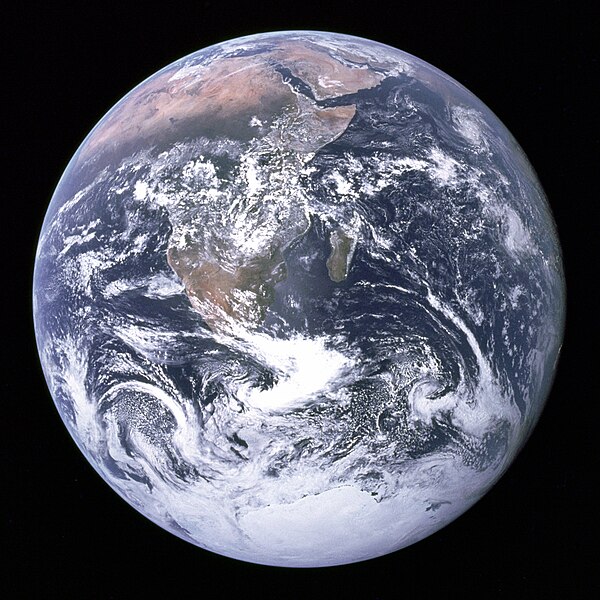
Image Source: Wikipedia - License: Public Domain (thanks to NASA)

Our Solar System
Our solar system consists of
1 star (Sun) and 8 planets (Mercury, Venus, Earth, Mars, Jupiter, Saturn, Uranus and Neptune).
- 1 AU (astronomical unit) is roughly the distance between Earth and the Sun (about 150 million kilometres).
- The space probe Voyager 1 was launched by the NASA in 1977 and is meanwhile (autumn 2015) about 133 AU away from Earth.
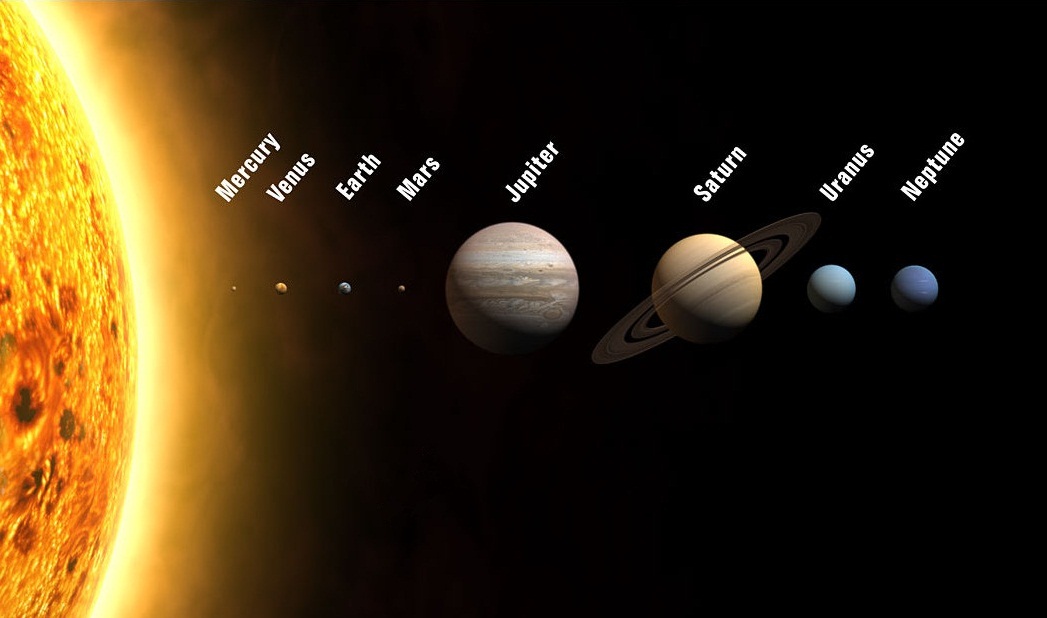
Image Source: Wikipedia - License: CC BY-SA 3.0
Why you should extend your general knowledge:
There are many reasons why one should or wants to extend his knowledge.
First you should consider that "general knowledge" is knowledge which a group of humans - who belong together regional, temporal or otherwise - owns. Thus, it describes a basic understanding of specific categories of knowledge.
As the English philosopher Francis Bacon said before: "Wisdom is Power" [Bacon 1597].